
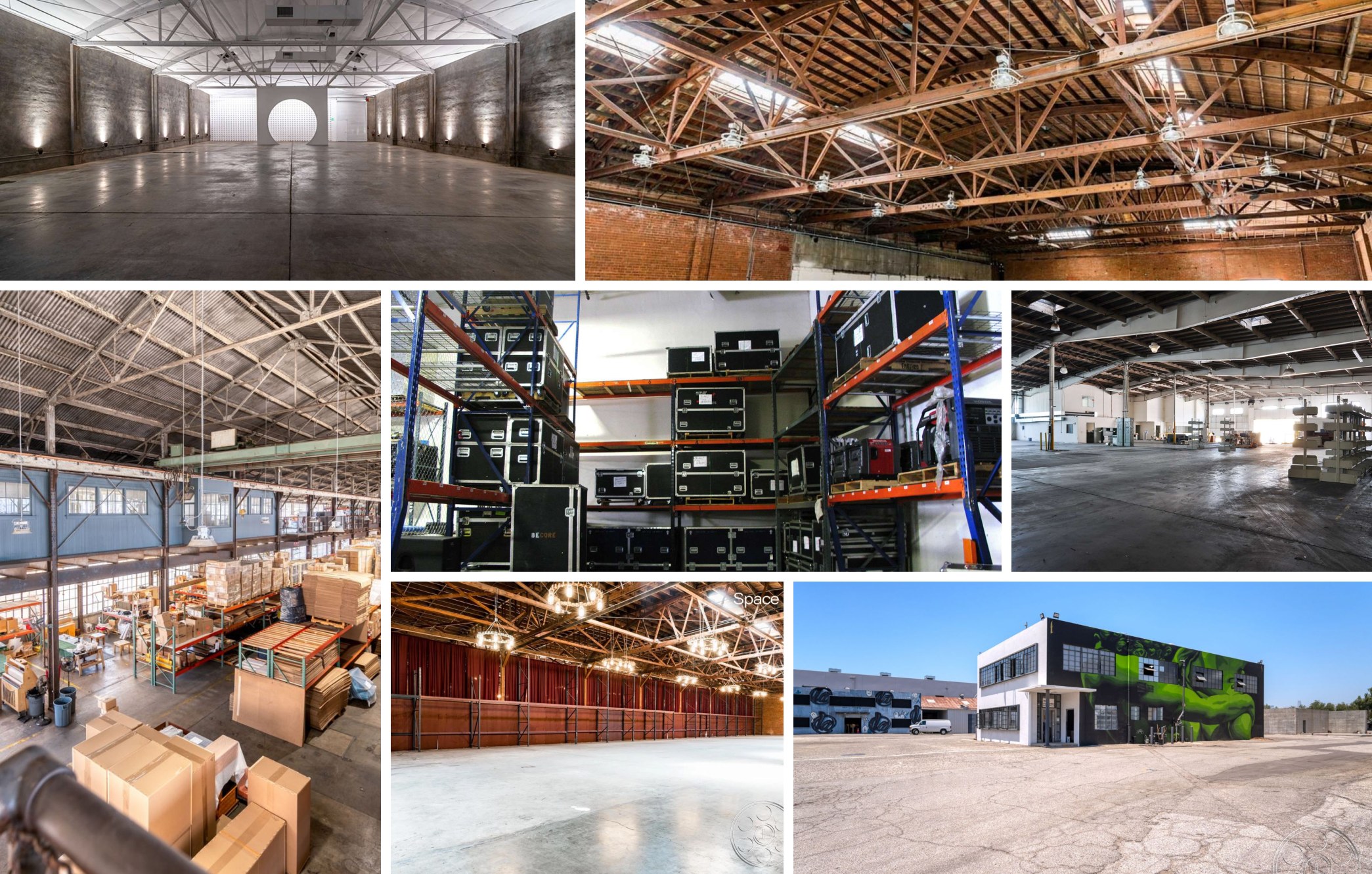
When a warehouse brief lands on our desk, the first thing we settle is the neighborhood. Brick in Boyle Heights does not look like steel in Vernon, and the permit office can change at a city line. Here is where the space is, area by area, and what decides the shoot day. We represent 70+ film-ready warehouse filming locations across the city, every one photographed and verified by our team.
Downtown LA and the Arts District

Downtown has the deepest warehouse inventory in Los Angeles, and it sits inside the studio zone, which keeps crew mileage standard. The historic core and the Arts District hold shells with original timber and steel, while the blocks toward the river run to bigger concrete spans. A space like Warehouse 9 shows the Downtown pattern: raw texture, high ceilings, and a location productions can pair with rooftops, lofts and street work on a single parking plan. Downtown also solves the company-move problem: a warehouse interior, a boardroom and an alley exterior can all sit within a few blocks of one basecamp. Warehouse 12 on 5th Street sits deeper in the same fabric. Browse the wider area on our Downtown LA filming locations page.
Boyle Heights: The Brick Belt

Cross the river into Boyle Heights and the stock gets older and warmer. This is the pre-war industrial belt, and it holds the city's best concentration of brick: worn walls, timber ceilings, and the patina art departments ask for by name. Our aptly named Brick Warehouse is the reference point, and Warehouse 2, Warehouse 28 and Warehouse 59 carry it across the neighborhood. On camera it passes for the East Coast, or for any older American city with a working past. Period features and music videos keep crossing the bridge for it. The neighborhood remains inside City of Los Angeles limits, so the permit path stays with FilmLA.
Vernon and the Industrial Cities

South of Boyle Heights, Vernon is an independent industrial city, and it runs its own film office, separate from FilmLA, so the permit path changes at the city line. What it offers in exchange is scale and control: whole blocks zoned for industry, where a production is nobody's neighbor. Studio 60 is a vast uplit clear-span with concrete walls that art departments treat as a blank stage. Factory 1 goes the other way: rusted steel trusses over a wall of factory windows. The same corridor of independent industrial cities continues south through Huntington Park and Commerce, where spaces like Warehouse 30 and Warehouse 60 extend the inventory along the Alameda corridor, each with its own city permit office.
Brick, Steel, and Daylight: Matching the Warehouse to the Script
The word warehouse covers three different looks, and choosing between them is a script decision before it is a budget one.
| Material | Reads as | Where it concentrates | Production notes |
|---|---|---|---|
| Brick and timber | Period, East Coast, working past | Boyle Heights, older Downtown blocks | Warm reflectance eats light; plan for more units. Rigging points need per-property confirmation |
| Steel and concrete | Modern industry, thriller territory | Vernon, river-adjacent Downtown | Trusses take rigging well; biggest clear spans; hard, cool surfaces |
| Daylight studio | Clean editorial, product, fashion | Converted stock citywide | White walls and skylights do the lighting work; floors clean enough for cyc work |

The converted end of the stock runs further than people expect: spaces like Warehouse 11 in the Arts District pair a warehouse shell with plywood millwork and skylights, reading as creative office, gallery or cafe as easily as industry.
Brick deserves the extra word because it is the scarcest of the three. Los Angeles industrialized later and built lighter than the East Coast, so surviving brick concentrates in the pre-war blocks near the river, and demand for it outruns supply every pilot season. It also behaves differently on set: the warm, absorbent walls swallow light that a white daylight studio would bounce back, so the same scene needs a bigger lighting package in brick than the floor plan suggests. When the schedule is tight or the units are few, that difference is worth knowing before the scout, not after.
What Productions Build Inside
The appeal of a warehouse is what it does not have. No drop ceilings, and no landlord fussing over the walls. Art departments build full sets inside them, stunt teams rig from the steel, and a bare concrete floor takes a fashion cyc as readily as a crashed car. Music videos use the raw shell as-is; features use the volume as a soundstage substitute when stages are booked out. If the plan involves construction, ask early about what can be fastened to the structure and what must be freestanding, because the answer differs per property and changes the build budget.
The Valley, the South Bay, and the Ports
When the schedule already lives at the northern studios, the Valley trades age for access: cleaner floors, easier trucks, less brick. VN Hangar in Van Nuys carries the aviation-scale end of that inventory. South and west, Studio 39 in Torrance serves the South Bay, and the port cities hold working stock like Warehouse 42 in Long Beach, where the harbor logistics are the location's own texture. When the warehouse is a set rather than a character, shooting close to the rest of the schedule is the smarter economics.
Load-In, Power, and Permits

Three questions decide whether a warehouse works before anyone talks about the look:
- Access. Many of our listings offer roll-up doors and drive-in floors, and some take full truck parking inside. Warehouse 19 on Mateo Street shows the shape: a full-height gate a truck drives straight through. Clearances differ per property, so confirm them against your grip package.
- Power. Older shells may need a generator plan even when the space itself is perfect.
- Permits. Shoots inside LA city limits run through FilmLA, while independent cities like Vernon use their own offices. Each listing shows its permit office.
Common Questions
Which LA warehouses are outside FilmLA jurisdiction?
Warehouses in independent industrial cities, with Vernon the most common example. Vernon operates its own film office, so a shoot that crosses from Boyle Heights into Vernon changes permit offices at the city line. Each of our listings names its office.
Can production trucks drive inside?
At many properties, yes. Roll-up doors and drive-in floors are common across the inventory, and a number of spaces take full truck parking indoors. Clearance heights vary, so we confirm them against your vehicle list before the scout.
Do warehouses work for sync sound?
Many do, with the usual caveats of working industrial neighborhoods: neighboring operations, roll-up doors, and hard reflective surfaces. If dialogue is the day's work, tell us early and we will point you at the quieter end of the inventory.
Send us the boards and we will shortlist the spaces that fit them.
